
How much does it cost to polish a car?
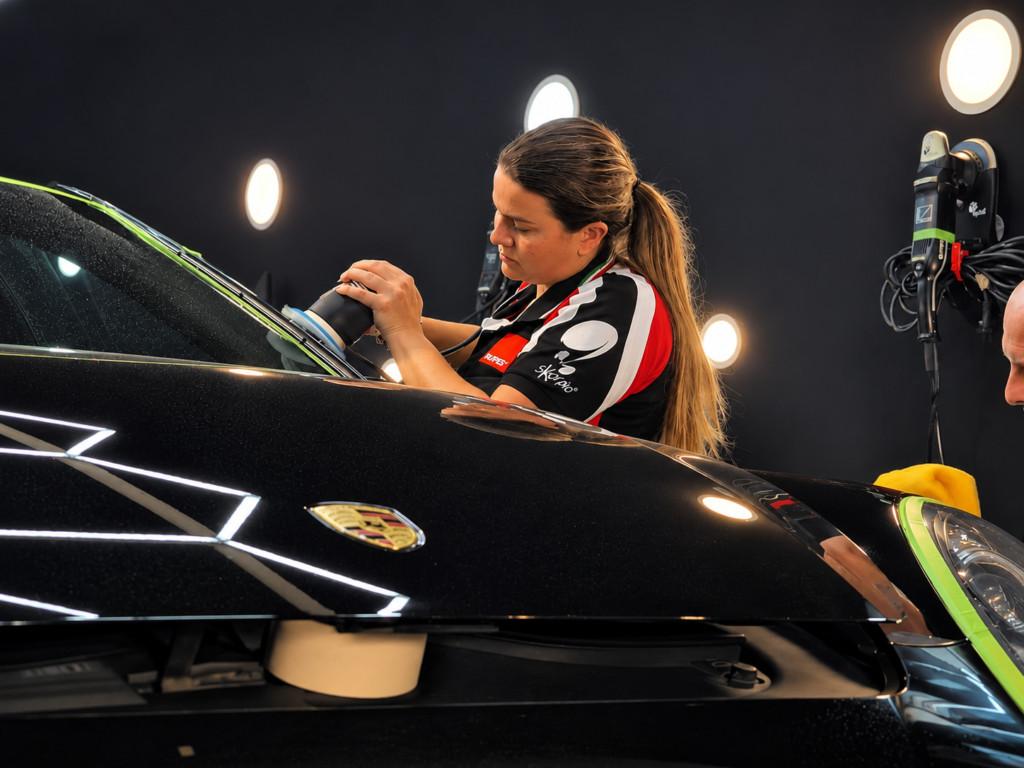
You ask for quotes in two places and get figures that look nothing alike. It’s not unusual: the cost of polishing a car depends less on the car itself than on the condition of its paint and the result you’re after. Two vehicles of the same model can need very different jobs, and that shows in the hours of work. Understanding what lies behind that figure helps you compare with judgement and avoid paying too much, or too little.
Why there’s no single price for polishing a car
Polishing a car isn’t a fixed service like an oil change. It’s manual work in which each panel is inspected, tested and corrected at its own pace. That’s why most professionals prefer to see the vehicle before giving a firm figure: what’s really being quoted is time, and time depends on what shows up under the light.
A proper assessment usually includes an inspection with lights that reveal swirls, scratches and water spots, and often a measurement of paint thickness. That diagnosis is what sets the cost of polishing a car: it tells you whether a light refresh is enough or whether a full correction is needed.
The condition of the paint sets the job
Bodywork that’s only a few years old with the odd wash scratch is nothing like one that has spent a decade in the sun. Car paint ages: it loses shine, builds up marks and, in a climate like Tenerife’s, takes the combined hit of radiation, calima dust and salty air. The more battered it is, the more passes it needs.
The clear coat matters too. Not all paints have the same hardness: some correct easily, while others need more time, more cutting products or different pads to achieve the same result. If there are old touch-ups or resprayed areas, the professional has to work them more carefully, because their thickness differs from the rest of the panel.
One-step or two-step polishing: what changes in the result
This is the difference that moves the price of a car polish the most. A one-step polish combines correction and finishing with a single compound: it brings back shine and removes a good share of light defects within a reasonable day’s work. It’s the logical choice for a well-kept vehicle that just needs its vibrancy back.
A two-step polish starts with a more abrasive compound that corrects the deeper defects and finishes with a fine one that leaves the surface like a mirror. It takes considerably longer and the result shows, especially on dark colours, where any hologram is visible in full sun. More steps isn’t always better: if the paint doesn’t need it, you’re only removing clear coat for no gain. In our gallery you can clearly see the difference between both levels of correction.
Size, preparation and protection: what also adds up
A city car and an SUV don’t have the same surface area, and every extra panel means more minutes of machine work. Then there’s preparation, which you don’t see in the final result but is essential: a thorough wash, chemical decontamination and, if needed, a clay bar to lift embedded dirt before touching the paint.
Next comes protection. After polishing, the paint is bare and should be sealed. Wax is the simplest option and the shortest-lived; a synthetic sealant lasts longer, and the price of a ceramic coating for a car includes even more meticulous preparation because the coating bonds directly to the clear coat. You can see these options in our services.
Cheap polishes: what the quote doesn’t show
Some quick polishes use products with fillers and silicones: the car comes out shiny, but that shine hides the defects instead of correcting them, and it disappears after a handful of washes. Others are done in a rush and leave holograms that weren’t there before.
Professional detailing is recognisable by the prior diagnosis, the test on a small area, the care taken around edges and trim, and a clear explanation of what will and won’t be corrected. A good professional will also tell you which defects won’t go away, rather than promising a perfect finish without having seen the car.
In the end, the cost of polishing a car makes sense when you know what you’re paying for. If you’d like to find out what yours needs, you can request an assessment and start from a real diagnosis, not a figure picked out of thin air.