
Many drivers use the two terms as if they meant the same thing, and they don’t. A wash leaves the car clean for a few days; detailing aims to bring it back to the best possible condition and keep it there. The difference isn’t in the soap, but in the goal, the method and the time spent on each surface. Knowing it helps you choose wisely depending on what your car needs at any given moment.
What each service is for
A traditional car wash has a clear purpose: to remove visible dirt quickly. It can be done in a tunnel, at a self-service bay or with a simple hand wash, and it does its job when the car just needs a once-over.
Detailing starts from a different question: what does this particular vehicle need to look its best? That means checking the paint, trim, wheels, glass and cabin, spotting defects and dealing with them one by one. It isn’t a more expensive wash, it’s a different job that starts with a diagnosis and ends with protection.
The exterior: from a quick wash to exterior detailing
In a conventional wash, the bodywork gets soap, a brush or sponge, a rinse and, at most, a dry. It works for removing dust and mud, but rollers and reused sponges are one of the main causes of the swirls you see in the paint in full sun.
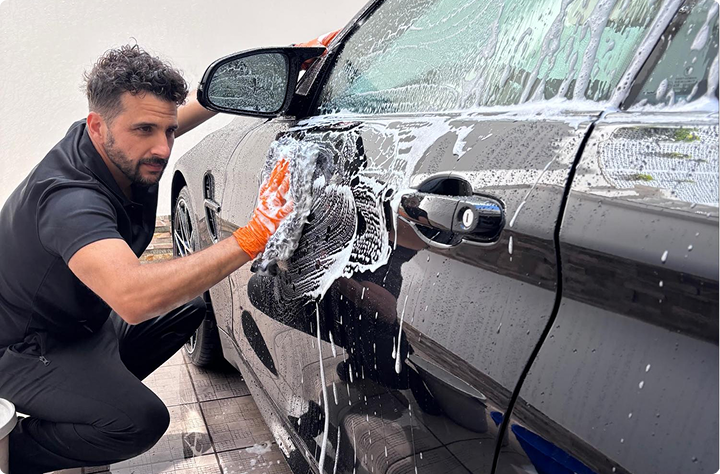
Exterior detailing follows an order designed to avoid damage: a foam pre-wash, a hand car wash with microfibre mitts and the two-bucket method, dedicated cleaning of wheels and wheel arches, soft brushes for badges, seals and grilles, and decontamination to remove embedded particles that water doesn’t shift. From there, depending on the condition of the paint, it may include polishing to correct defects and a layer of wax, sealant or ceramic coating. Our gallery clearly shows how much a car’s bodywork changes after this process.
The interior: vacuuming versus deep cleaning
Inside, the difference is even more obvious. A standard wash usually just vacuums the mats and seats and wipes a cloth over the dashboard.
An in-depth car interior clean goes much further. Interior detailing includes thorough vacuuming of corners and seat rails, cleaning panels, the centre console and air vents with brushes, treating plastics so they don’t dry out, and cleaning upholstery with extraction where there are stains. What you can’t see, such as vents or seams, also counts, because that’s where dirt and odours build up. If the car has leather seats, they’re cleaned and conditioned so they don’t crack in the heat.

Time, products and results
A conventional wash is done in no time. A full detail can take several hours or even a whole day, depending on the size of the vehicle and its condition. That time isn’t padding: it’s what allows each panel to be worked without rushing and the result to be checked under proper light. Before starting, the car is also inspected to agree on what will be corrected and what result to expect, something that simply doesn’t happen with a quick wash.
The products change too. Car detailing uses specific cleaners for each material, with a suitable pH so as not to damage delicate surfaces, instead of a single soap for everything. The result shows in the shine, but above all in how long it lasts: a well-protected car gets less dirty and is easier to clean at every subsequent wash.
When to choose each one
This isn’t about giving up traditional washing. For weekly maintenance, a good hand wash is more than enough, as long as it’s done carefully. Regular car cleaning is, in fact, what best preserves the work of a detail.
Detailing makes sense at specific moments: when you buy a second-hand car, before selling it, when the paint has lost its shine or the interior needs more than a vacuum, or once or twice a year as a tune-up. You can see the different levels of cleaning and correction in our services, and if it’s more convenient, many of them can be done through our mobile service.
Thinking of detailing as an investment in the car’s condition, rather than a whim, changes the way you look after it. If you’re not sure which option suits yours, drop us a line and we’ll assess it with you.